Marcello Di Cintio

Archive for 2010|Yearly archive page

In progress: San Diego, Tijuana, and the bars of Tucson

In Uncategorized on December 23, 2010 at 6:33 pm

Miss Peggy, 80 year-old bartender at The Buffet

The bulk of my time along the US-Mexico border last month was spent doing research for my Walls book. However, I also managed to collect material for a few stories I am writing for Up!, the in-flight magazine of Westjet Airlines. This is much lighter fare than my walls work, but after a month among the sadness and despair of the borderlands, writing these travel stories will be a welcome relief.

My first assignment is a series of short pieces about San Diego that investigate the border-qualities of the city. The most interesting thing about San Diego, I found, was the collision and collusion between the culture of American California and the Baja south of the la ligna. I met gringo-American tattoo artists inspired by Mexican ‘Day of the Dead’ motifs, and a restaurateur who opened a fantastic gastro-cantina named El Take it Easy that serves what can be best called border cuisine. Even the San Diego Children’Museum refers to to the border in its exhibits, especially in a piece called Toy An Horse: an enormous two-headed Trojan horse looking simultaneously south to Tijuana and north to San Diego.

I am also working on a feature story about reconsidering Tijuana. The city, known as TJ by affectionate anglos, has seen a crippling reduction in cross-border tourism in the past decade or so. As a result, the locals have reclaimed Avenida Revolución, the main tourist street. Shops that used to sell sombreros and trinkets to Americans have been transformed into galleries and smart cafés for Tijuanese artists. The nightclubs that try to lure Americans with girls and cheap tequila are nearly empty, but in the old 70s-era cantinas local hipsters share the padded bartops with aging Mexican drinkers. I spent a glorious Monday night touring these cantinas with an American expat living in Tijuana, and I am looking forward to writing it all down.

Lastly, I will write a story about great character bars in Tucson. Or, more accurately, the great characters who work in Tucson’s great character bars. This story will feature Miss Peggy, the 80 year-old bartender at The Buffet; a 77 year-old barkeep named Tiger who has tended the Hotel Congress’ Tap Room for the last fifty-one years; Jim Anderson, ‘consultant’ at The Meet Rack who is a cross between a mad genius and a dirty old man (most of what he said in our interview is unprintable); and Kate Miners, also known as Madame Inga Kaboom, co-owner of The Surly Wench Pub and founder, director, and sometimes-dancer of the house burlesque troupe: Black Cherry Burlesque.

Tiger

A publisher for ‘Walls’!

In Uncategorized on December 6, 2010 at 2:56 pm

I’ve known this for a few months now, but this morning I finally signed the contracts and can now make the ‘official’ announcement: In the Shadow of the Walls -  my book-in-progress about my travels along walls, fences and barriers around the world – will be published in Canada by Goose Lane Editions.

Goose Lane showed great enthusiasm for this project and I am excited to start working with them. We are looking at a publishing date in 2012. Before then, however, I have a lot of work to do. Two more research trips . Three chapters left to write. Five chapters to edit. An introduction to figure out. I predict 2011 is going to fly by.

“Memento Mirmy” is online

In Uncategorized on December 6, 2010 at 2:38 pm

My profile on ‘rogue taxidermist’ Mirmy Winn is now online on The Walrus Magazine‘s website.

Mirmy is the Vancouver artist I met in the fall who creates  compelling work with, among other things, unloved mounted weasels and human bones. I will never forget the smell of the human skull she let me hold.

The story is here.

“Fatherhood” is online

In Uncategorized on December 3, 2010 at 11:25 am

My story about becoming a father, which I’ve mentioned ad nauseam on this blog, is now online in its entirety. Find it here.

Wall of Sadness

In Uncategorized on December 3, 2010 at 11:12 am

This afternoon I will leave America’s southern borderlands and cross the northern frontier into Canada. I am going home. My month here in southern California and Mexico has been rich in terms of research for my walls book. I haven’t done any new writing for this project in months now – I needed to gather more material – and I am looking forward to sitting at my desk in Calgary and processing all that I’ve learned here.

As I go through my notes, I realize that although the Wall inspires anger and frustration, the prevailing emotion along the Wall is grief. I’ve witnessed many tears on this trip. I watched newly captured migrants – many still in their torn crossing clothes – stand eight at a time before a judge in federal court and plead guilty to the crime of illegal entry. When they shuffled out of the courtroom, the chains that linked their ankles to their wrists rattled over their weeping.

In Nogales, at a ‘soup kitchen’ for recent deportees, a migrant family wept when they described the bravery of their nine year-old daughter as the family crossed the desert. “Have courage,” the girl told her parents. “We will make it this time.” They didn’t. Now they sit on the Mexican side of la ligna wondering if it is worth trying to cross again.

I met an undocumented woman in Tucson who cried when she told me that she couldn’t travel to Mexico to attend her father’s funeral. Leaving America would necessitate another illegal crossing and increased border security made this too risky and dangerous. The woman nearly wept again when she told me that she had explained to her three teenage children that one day they might come home from school and find their mother has been taken away to prison. “I told them that if that happens, they must continue their studies,” she said. “No matter what.” Every morning she kisses and hugs her children as if today might be the day.

Someone said to me that the Wall is a wall of hate, but maybe it is more a wall of sadness.

To the Migrants’ Shrine

In Uncategorized on December 2, 2010 at 2:22 pm

Christianity is thick on the borderlands, and I’ve spent much of my time here among people of faith. Jesuits ran the Comedor de los Migrantes in Nogales. All three of Tucson’s migration activist groups – Humane Borders, The Samaritans, and No More Deaths – originated out of faith-based groups. Mark Adams, a Presbyterian Minister, runs Frontera de Christo. He told me that his life in the borderlands changed his perception of the Christmas story. Now he sees the birth of Jesus as a migration of God from the divine to the human. (I am not a believer, but this is a compelling reading of scripture.)

The migrants themselves, being primarily Mexican, are primarily Catholic. The migrants draw on their faith to guide and protect them on their long crossings through the desert. Despite the urgency of the journey, the risks of the desert, and the cold of the night, those that cross from there to here make the time to pray.

Earlier this week I hiked one of the migrant trails with members of No More Deaths and a group of high school students. We followed our guide single file past Arivaca Lake, along the river wash, and through the thick mesquite and acacia. The pathways are ancient.  Animals first trampled into the routed into existence centuries ago, then the local Native peoples used them. Now groups of migrants, led by Mexican guides called coyotes, trod northward up these paths.

The stories of these migrations are told by the items they leave behind. We found battered backpacks abandoned on the ground. Empty tuna cans. Water bottles. A torn L.A. Dodgers jacket and a pair of discarded blue jeans. A crushed can of Red Bull. Coyotes give Red Bull to their clients when they start to fatigue, but the high levels of sugar and caffeine are dangerous for bodies weakened by the journey.

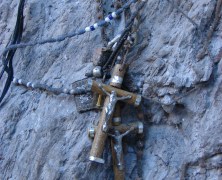
Our own journey ended where rock walls rose on both sides of the path to form a kind of protected alcove. Passing migrants had transformed a natural shelf of rock into a shrine. Migrants prayed here for a successful crossing. They hung rosaries and and prayer books and portraits of saints. The travelers lit candles here; broken glass votives littered the ground around the shrine. Migrants travel light. They carry everything they need on their backs. Yet they find space for candles to light during their journey. The implements of faith are as necessary as bottles of water and cans of food.

My Mexican Grandfather

In Uncategorized on November 28, 2010 at 3:04 pm

Yesterday morning I traveled across the border to Nogales, Sonora to visit the Comedor de los Migrantes, a Jesuit-run cafeteria that serves meals to recently deported migrants. At least a third of the migrants who lined up for a breakfast of pozole soup and tortillas had been captured my US Border Patrol agents and deported the night before. After cold nights in the desert, some of the women used the hot tortillas to warm their hands before dipping them in their soup.

After the meal I had the chance to meet a family of migrants who were captured in the desert two nights earlier. There was four of them: a mother, a father, and their two young daughters – about ten and seven years-old – who played with a stray kitten while I talked to their parents. The father had crossed illegally into the US many months before and found construction and concrete work in Seattle. He returned to Mexico to bring over his wife and daughters, but were caught after two days in the desert.

The story of this family parallels my own. My grandfather was a farmer in rural Italy. He, too, had daughters and he, too, travelled to North America to find work to give his wife and girls a better life. He settled in Canada, but like the Mexican father, he found work doing construction and pouring concrete. And like the Mexican father, he eventually he sent for his wife and daughters to join him. Sitting across from this man was like seeing my own grandfather a half-century ago.

The difference, many people would say, is that my grandfather did this legally.

My grandfather in in his eighties now. The daughters he brought to Canada granted him seven grandchildren, and his sixth great-grandchild will be born before Christmas. If he looks out at Calgary’s downtown skyline, my Nonno can count the buildings he helped construct. I can’t see how his contribution to Canadian society would seem any less had he not had a envelope filled with papers saying that he legally belonged.

When people here on the border talking about solving the immigration problem, sometimes I wonder what the problem really is.

The Tohono O’odham and the Wall

In Uncategorized on November 26, 2010 at 11:36 am

Two days ago I traveled into the Sonoran Desert and the Tohono O’odham Indian Reservation. The landscape reminded me of my time in the Sahara, especially in the refugee camps of the Saharawi. In both deserts, the dwelling places are simple one-story structures occupied by people named for the desert itself: both Saharawi and O’odham mean, essentially, ‘people of the desert.’ The aesthetic role of the camel in the Sahara is played in the Sonora by the Saguaro Cactus. Each acts as the part-comic, part-elegant icon of their respective landscapes.

I traveled to the reservation to meet with Ofelia Rivas, an O’odham elder and activist, to speak with her about the border wall. Ofelia is a marvelous woman. She has been advocating for her people’s rights for many years. Recently, she toured with a punk band called Resistant Culture and spoke to audiences about indigenous issues along the borderlands. She also met the Dalai Lama in Tucson. Ofelia told me how she pressed her forehead against his, closed her eyes, and spoke to him in her native language about the troubles facing her people. “I felt that he could understand me,” she said.

O’odham territory spills over the international border into Mexico. It is a huge expanse of land; the reservation on the US side alone is the size of Connecticut. Ofelia told me that traditional O’odham belief requires people to travel freely across their lands, to care for and maintain the holy sites, and to make pilgrimages along the traditional routes. The O’odham used to move freely across the border. The line meant nothing to the O’odham, after all, since they occupied these lands long before there even was a United States or a Mexico.

But 9-11 and the fortification of the border changed things for the O’odham. Tribal members from both sides of the line now needed formal documentation to cross the border. Many O’odham, Ofelia among them, were not born in hospitals and did not have their birth officially recorded anywhere. They did not have the proper documents. The increased border security also means that Border Patrol agents insist on searching through the medicine bundles O’odham elders use in their ceremonies. These bundles are sacred and not to be handled by anyone not involved in the ritual. To search through these holy packages as if they were carry-on bags at an airport is a great insult to the O’odham. Ofelia told me that once a Border Patrol agent snapped apart the antlers on a ceremonial headdress to see if there were narcotics hidden inside.

The border wall has also changed the way O’odham on either side of the line view each other. For the first time, the members refer to the Mexicano O’odham and the Americano O’odham. O’odham south of the border consider northern O’odham privileged – though one look at the poor reservation settlements near the border puts this notion to rest. The situation reminds me of the rural villages along the India-Bangladesh border (which I wrote about here). Families on one side of the line did not consider themselves any different from their counterparts on the other side until India built a fence. The steel and wire gave rise to feelings of difference that never existed before. The walls are impotent; the walls are powerful, too.

Ofelia brought me to the borderline. A wall made of steel tubes planted five feet into the ground and filled with concrete is designed to stop vehicles from crossing. As we stood and stared into the expanse of O’odham land on the other side, Ofelia told me that since the wall went up, eleven O’odham elders had died. “One after another,” she said. Ofelia believes that the stress and sadness born out of the border wall was one of the reasons these elders died. “They couldn’t comprehend what was happening,” she said.

“My hair used to be long, but I cut off a piece for every elder’s death ritual. By the end of the year my hair was gone.”

Sounding the Wall

In Uncategorized on November 17, 2010 at 1:54 pm

“Bach played in cathedrals,” musician Glenn Weyant told me. “The Sonoran Desert is my cathedral.” And Weyant’s instrument is the border wall.

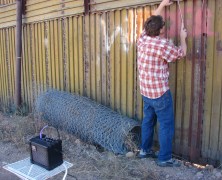
I traveled to Nogales with Weyant and watched him attach a contact microphone to the border wall. He plugged the mic into an amplifier and the wall sings before it is even played. The wall vibrates in the wind. The sun warms the metal – recycled helicopter landing mats from the first Gulf War – and the panels creak and pop. The microphone revealed that the wall, meant to restrict movement across the border, is itself constantly moving.

But the wall’s natural moans did not satisfy Weyant. He wanted to “sound” the wall. Weyant adjusted the volume on the amplifier and tapped the wall with drum sticks made of palm fronds. He dragged a snare brush across the ridges, and bowed the metal edges with a cello bow. “I have to be careful. Steel will eat the bow,” he said. The taps and rattles emanated out from the amplifier and into the border hillsides where Border Patrol officers and National Guard troops watched on bewildered.

Weyant’s soundings encompass more than just his percussive playing on the wall itself. The sound of dogs barking and border patrol vehicles passing end up on his recordings. So does street noise from the Mexican side of the wall. Weyant once played a ‘duet’ with a Black Hawk helicopter patrolling the border overhead. All these sounds form a chorus, Weyant says. “The wall is a resonator. A unifier. It doesn’t discern between sounds on one side of the other.” In this way, Weyant’s soundings turn something meant to divide into something that unites.

Weyant offered to play a duet with me. I selected a palm frond and a metal whisk from Weyant’s sack of implements. Then I stood up to the wall and Weyant and I played the wall. Weyant says that playing the wall makes beauty out of its ugliness, but I am not sure my taps and knocks, transmitted through wire and echoed through the speaker, sounded beautiful. There was, however, something beautiful in the absurdity of the action. From a distance, two men making music from on a metal wall seems ludicrous. Then again, what is more ludicrous than the wall itself?

The Fence at Friendship Park

In Uncategorized on November 11, 2010 at 5:44 pm

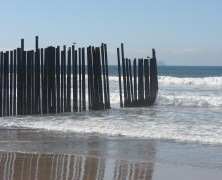
The Wall doesn’t end as much as it diminishes. Here, on the white sand between San Diego and Tijuana, the recycled Gulf War landing mats that form the border fence give way to a row of posts that lean like drunks in the surf. America and Mexico begin and end here, but the ocean doesn’t care about the lines men draw in the sand. It dumps kelp on the beach and crusts the fence with rust.

The place is called Friendship Park, and the name is a punchline now. I first visited the park with Reverend John Fanestil who used to serve communion through the posts to Mexicans on the other side. The border guards ordered him to stop and led him away in handcuffs when he didn’t. Passing wafers across the border was a customs infraction. The walls, here and elsewhere, breed such absurdities.

Families used to come and touch their loved ones on the other side. Mothers held the hands of their deported sons. Husbands reached through to touch their wives’ faces. John told me about one man, an ex-con unable to cross into Mexico, who met his girlfriend every Sunday at the fence and tried to convince her to marry him. She stood on the other side, holding their infant son, surmising through the fenceposts whether she could love this man forever.

The touching has ended. A new fence, tall and steel, is too far from Mexico for fingers to reach. On the weekends, humourless border guards open a gate and allow visitors on the American side to pass through the new barrier and into a fenced enclosure locals call ‘the cage.’ Visitors can get near enough to the other side to speak with family on the other side but they are too far to touch anymore. This is the poetic tragedy of this place. Once you could touch. Now you cannot. I wonder if this is worse than never having touched at all.

On my second visit to the fence I saw a family visiting the Mexican side. They all lived in San Diego, but traveled across the border to visit their father, Peter, who had been deported to Tijuana. From through the fence, Peter told me that he found the barrier dehumanizing and degrading. He accepted his deportation, but feels that “this is not the way it should be. This place should be built for families. It should be comfortable.” Besides, the fence interfered with his fatherly duties. He smiled and pointed at his teenage daughter. “If she causes trouble, how am I supposed to pull her ear?” he joked. “What am I supposed to do? Throw a rock at her from over the fence?” His family laughed.

Follow

Get every new post delivered to your Inbox.

Join 139 other followers